Last Updated: November 1, 2026
Quick Summary
The best way to save money on moving supplies is to make a checklist first and buy only what you need. Check what you already own, count boxes room by room, and look for free boxes at grocery and liquor stores, after inspecting each one.
- Write a checklist by room and check off supplies you already own.
- Estimate boxes by packing one room at a time, then add 10 to 15 percent extra.
- Ask grocery, liquor, and bookstores for free boxes, ideally on weekday mornings.
- Inspect used boxes for moisture, pests, odors, and weak bottoms before using them.
- Use towels, clothing, and socks for fragile items, but not for screens or heavy stoneware.
Table of Contents
- Start With a Moving Supplies Checklist
- How Many Moving Boxes Do I Need?
- Where to Find Free Moving Boxes
- Using Household Items as Packing Materials
- Booking Your Moving Totes for a Simpler Move
- Frequently Asked Questions
Start With a Moving Supplies Checklist
Saving money on moving supplies starts with knowing what you actually need. Most people overbuy, then pay for tape, paper, and boxes they never use.
Write down each room and what goes in it. Then list the supplies each room needs. Here is a basic starting list:
- Boxes or containers, sized for books, kitchen items, and clothing
- Packing paper or old newspaper for wrapping
- Packing tape or a tape gun
Check off what you already own before you buy anything. Many people find they have half of this list in a garage or closet.
Watch out: Buying supplies before you finish decluttering means you may pay to pack things you plan to donate or sell.
How Many Moving Boxes Do I Need?
A common rule is to estimate about one box per 100 square feet of living space, then adjust for how much you own.
Use a quick count instead of guessing:
- Pack one room at a time and note how many boxes it fills
- Multiply that number across your other rooms
- Add 10 to 15 percent for extras, like fragile items and last-minute packing
Heavy items like books should go in smaller boxes so they stay manageable. Keep track of your count as you go so you know when to reorder.
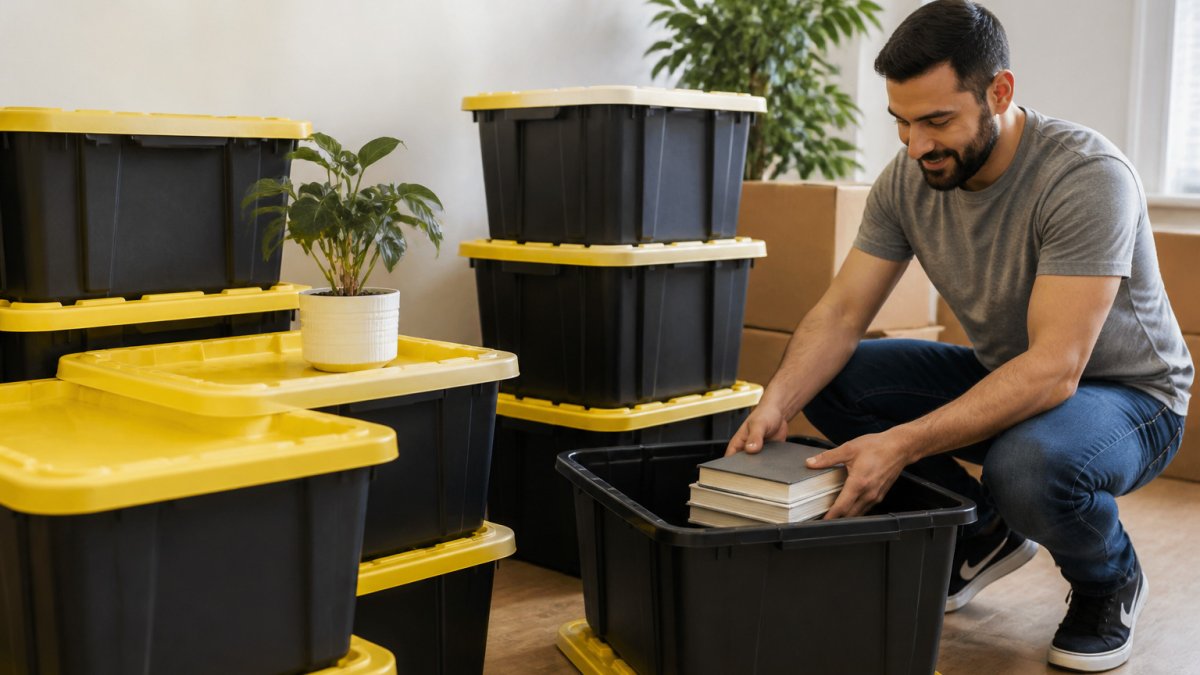
Moving boxes vs. plastic totes is another decision here. Reusable plastic moving totes are one option, and they come in a consistent size, which makes counting and stacking easier than mixed cardboard sizes.
Where to Find Free Moving Boxes
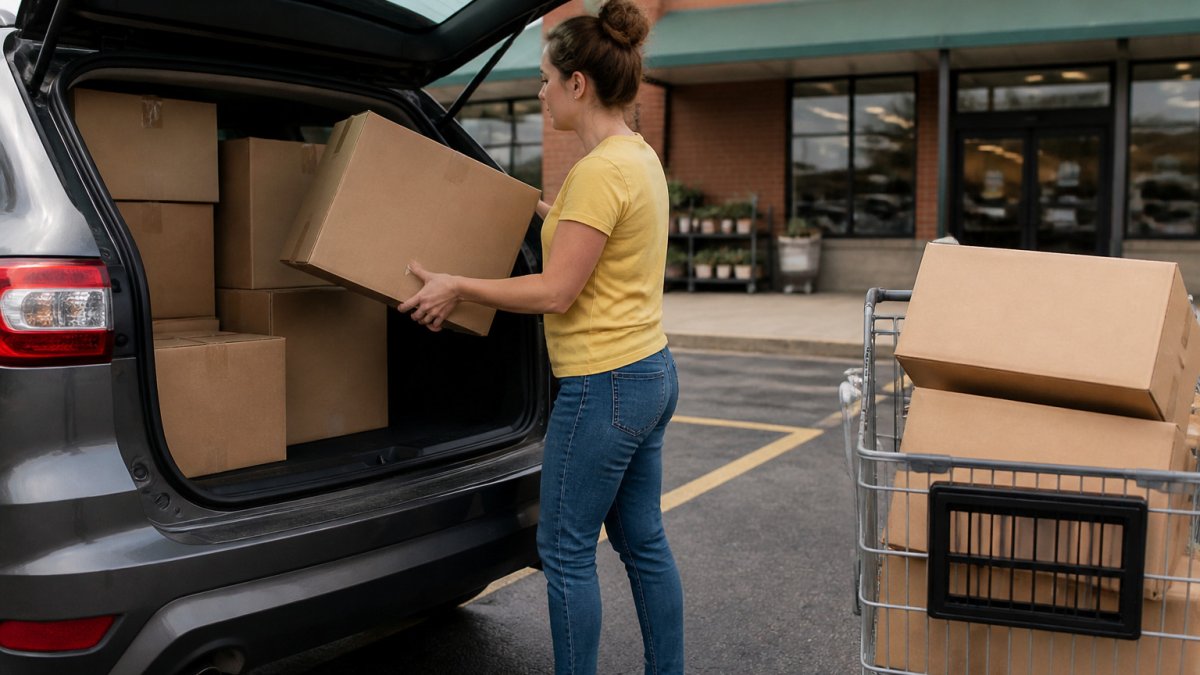
Free boxes are the most common way people cut moving costs, but the difference between a good free box and a bad one is inspection. If free boxes come up short, you can read about reusable plastic moving boxes delivered to your home. A crushed or damp box can fail mid-carry or transfer odors and pests to your belongings. Treat every free box as a candidate, not a certainty.
The best places to ask
- Grocery stores. Produce and dairy departments receive shipments daily. Ask the produce manager on a weekday morning, before the baler runs.
- Liquor stores. Boxes with dividers are excellent for glassware and bottles. Ask the manager rather than digging through the bin.
- Bookstores. Book cartons are sturdy and uniform, which makes stacking easier.
How to inspect a used box before you take it
Run every box through this quick check:
- Squeeze the corners. If the corners crush easily or feel soft, the box has lost structural strength.
- Look for moisture. Dark patches, soft spots, or a musty smell mean the box was wet. Skip it, damp cardboard grows mold and loses strength.
- Check for pests. Look for droppings, gnaw marks, egg cases, or live insects in the seams and flaps.
- Smell it. A box that held food, chemicals, or pet supplies can transfer odors to clothing and bedding.
- Confirm the bottom. Flip the box over and press the bottom flaps. If they bow or separate, the box will fail under weight.
A practical local sourcing plan
Rather than driving store to store, build a short route:
- Call ahead. Ask each store when they receive shipments and whether they will hold boxes for pickup.
- Ask about pickup windows. Most stores will not hold boxes past a shift, so arrange a time the same day.
- Bring a friend or a cart. Flattened boxes are bulky; a second set of hands saves trips.
If you are moving in Davenport, Bettendorf, Moline, Rock Island, or a nearby community, the same route works, start with grocery and liquor stores closest to you, then widen the loop only if you come up short.
If free boxes are scarce or inconsistent in size, reusable plastic moving boxes are an alternative that arrives uniform and stackable. You can browse moving boxes and totes to see whether a rental fits your timeline.
Using Household Items as Packing Materials
You do not need to buy specialty packing material for everything, but household substitutes are not one-size-fits-all. Find step-by-step packing guidance for fragile items to protect breakables safely. The right approach is to match the material to the item, and to know when a substitute is unsafe.
What household items protect well
- Towels and blankets cushion dishes, glassware, and framed art. Wrap each fragile item individually and pack it upright, with padding on all sides.
- Clothing and linens fill gaps around electronics, lamps, and small furniture.
- Socks slip over stemware and small glass pieces better than paper.
- Suitcases and duffel bags carry clothes and bedding, so those items need no box at all.
Where household substitutes fall short
Some items need purpose-made protection, and a towel is not a substitute:
- Screens, monitors, and TVs. Soft fabric does not prevent flex or impact. Use the original box if you have it, or rigid foam and a sturdy carton.
- Mirrors and framed glass. Fabric can press against the surface and crack it. Use cardboard corner protectors and glass tape, or have the item professionally packed.
- Heavy stoneware, ceramics, and marble. Fabric compresses under weight. These need rigid separators and a double-boxed carton.
- Anything with a finish that fabric can scratch. Dust and grit trapped in a towel can mar furniture and electronics.
Packing paper: what to use and what to skip
Plain newspaper can leave ink on dishes, glassware, and anything you plan to use again. Use clean, unprinted paper, packing paper, butcher paper, or unprinted newsprint, for items that touch the surface. Save printed newspaper for filler between layers, where it will not contact the item.
A quick materials plan by room
- Kitchen: towels and socks for everyday dishes; purpose-made dividers for fine glassware; clean paper for plates.
- Bedroom: suitcases for clothes; blankets for lamps and mirrors (with corner protection).
- Living room: clothing for electronics gaps; original boxes for screens; rigid foam for anything with a glass panel.
- Home office: copy-paper boxes for files; bubble wrap or foam for monitors; towels only for cables and accessories.
If you would rather skip the box-and-tape routine entirely, reusable plastic moving boxes offer a uniform, stackable alternative that needs no assembly and no tape to close. You can see how moving totes work and decide whether a rental fits your move.
Household items can protect many belongings, but each material suits different things.
| Item | Best for | Caution |
|---|---|---|
| Towels and blankets | Dishes, glassware, framed art | Wrap each item individually |
| Clothing and linens | Gaps around electronics and lamps | Not for heavy stoneware |
| Socks | Stemware and small glass pieces | Use for light, small items only |
| Suitcases and duffel bags | Clothes and bedding | No box needed |
| Clean packing paper | Plates and items that touch the surface | Avoid printed newspaper |
| Original boxes | Screens, monitors, and TVs | Soft fabric alone is not enough |
| Rigid foam and cardboard corners | Mirrors and glass-panel items | Fabric can press and crack glass |
Booking Your Moving Totes for a Simpler Move
If you want to skip box assembly, tape, and cardboard piles, reusable plastic moving totes are a practical choice. You can reserve your moving totes for delivery and pickup in the Quad Cities area.
Totes stack well in the truck or on the garage floor, and they keep items protected through the move. Check whether we serve your town by viewing moving box and tote rental across the Quad Cities and surrounding areas.
Ready to simplify your move? Reserve Totes with QC Tote Rental and spend less time hunting for boxes.
Frequently Asked Questions
Where can I find free moving boxes?
Many stores, including grocery and liquor stores, often have sturdy used boxes available, especially on weekdays after deliveries. Bookstores and clothing shops may also have boxes they are willing to part with. Ask a manager before taking anything, and check each box for crushed corners, water damage, or weak bottoms. Online community groups and neighborhood message boards are another common source, where people post boxes they no longer need. Pick up boxes soon after you ask, since they can be gone quickly.
How many moving boxes do I need?
The number depends on how much you own and how many rooms you are packing. Start by walking through each room and listing what goes into boxes, then estimate roughly how many boxes each category will fill. Books and kitchen items take more boxes because they are heavy, while clothing and linens can fill larger containers with fewer boxes. Packing one room at a time and counting boxes as you go gives a more accurate total than guessing at the start. Keep a few extra on hand for last-minute items.
Can I use household items instead of packing materials?
Yes. Towels, blankets, bedding, and clothing can protect fragile items such as glassware and dishes, which saves buying bubble wrap for every piece. Suitcases, duffel bags, and plastic tubs can hold clothes and smaller items, and they often double as transport containers. Wrap breakable items in clothing or linens and place them in the center of a box, surrounded by softer items. This approach reduces the number of purchased supplies you need, though heavy or very fragile pieces may still need additional padding.
Should I use reusable moving boxes instead of cardboard?
Reusable plastic moving totes are one alternative to cardboard boxes for residents in the Quad Cities. They arrive ready to use with no assembly, no tape required to close, and consistent sizing that makes stacking easier in a moving truck or storage space. After the move, the totes are picked up rather than left as piles of cardboard to break down and haul away. Pricing depends on quantity, dates, and delivery, so visit the QC Tote Rental website for current rates or a quote.
